
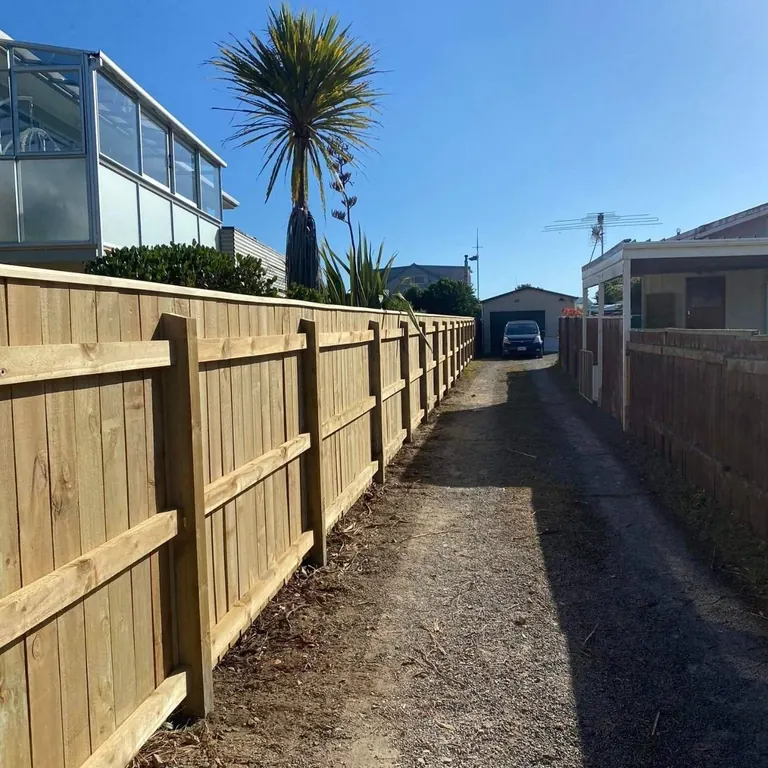
Define what the new fence needs to do
A fence can give privacy, organise an entrance or replace a deteriorated boundary. Tell us the main purpose first, then identify the sections that need work. Our timber fencing service can be discussed around the particular layout and access at your property.
Walk the line and label each section on a sketch. Mark the street end, corners, gates and anything you want retained. Take both a wide photo and close views of damaged areas. This makes it easier to distinguish a short repair from a complete replacement and to discuss how the new and retained sections will meet.
Settle the Lower Hutt boundary and council questions
Hutt City Council’s fence guidance covers building and resource requirements. Check the proposed fence at your address, including its height and position. Pool barriers and structures that retain ground need their own assessment.
Confirm the boundary position before setting out work. Discuss the proposed fence with the adjoining owner and record the agreed scope, access and cost arrangements in writing before construction. If the line or agreement is uncertain, resolve that first so the building brief rests on a clear starting point.
Specify each section, then the gates
Replacement length
Give an approximate length for each section. Show what comes out, what stays and whether old materials need removing from the property.
Height and privacy
Describe what you want screened from each side. Mark changing ground levels rather than using one height for the entire boundary.
Gate use
List what needs to pass through: people, bins, bikes or larger items. Show the opening direction and space available behind it.
Site access
Record narrow passages, planting and places where materials can be stacked. Identify services or other features that need checking before digging.
A useful fence enquiry in five parts
- Property address and a sketch showing the boundary in question.
- Photos along both sides where you have access.
- Approximate lengths, desired height and gate requirements.
- A note of any retaining wall, pool area or uncertain boundary position.
- What has been agreed with the neighbour and how access will work.
When reviewing a scope, use the same inclusion checks as our guide to comparing renovation quotes: removal, materials, installation and finishing should be clear. Our consent planning guide explains questions to settle before building.
For another property, see the site-preparation advice for timber fencing in Upper Hutt or timber fencing on the Kāpiti Coast.
Can we replace only part of a fence?
We can assess the affected section and the condition of the posts and adjoining fencing. Send wide photos as well as close-ups so we can discuss how a repair or partial replacement would connect to what stays.